Early
Harp History I
Thousands of Years
of Fascination
for the Harp
Earliest Harp History
The harp is the oldest known
stringed instrument. The word "harpa" or "harp"
comes from Anglo-Saxon, Old German, and Old Norse words meaning
"to pluck". By the 13th century the term was being
applied specifically to the triangular harp as opposed to
the lyre harp. The earliest Gaelic term for a wire-strung
instrument was "cruit" was applied specifically
to the harp by 1200. A later word used in Scotland and Ireland
for the "Celtic" harp was clarsach or cláirseach.
Scottish records of the 15th and 16th centuries show that
both the terms "harp" and "clarsach" were
in use at the same time, and seem to indicate that there was
a distinction between the gut-strung European-style harps
and wire-strung Gaelic clarsachs.
Today, we know the Gaelic harps
as the Irish, Celtic, Folk, Scottish Clarsach or the modern
lever harp. Most folk harps are strung with a combination
of nylon, metal, gut and/or synthetic gut (carbon fibre) strings.
Brass wire strung harps continue in the Gaelic tradition.
No one really knows where the
harp originated and we will never know what harp music sounded
like in the pre-historical era. One of the earliest musical
instrument discoveries showed a harp-like instrument on rock
paintings dating back to 15,000 BC in France. Many believe
that the earliest harps came from the sound of the hunter's
bow
In Egypt, some of the earliest
images of bow harps are from the Pharaoh's tombs dating some
5,000 years ago. These hieroglyphs show that there were many
harps in ancient Egypt. The Egyptian Pharaoh Ramses III (1198-1166
BC) had many bow harps painted in his tomb. In the New Kingdom,
harps measured up to 2 metres (6.5 feet) in height with 19
strings and were played seated or standing up.
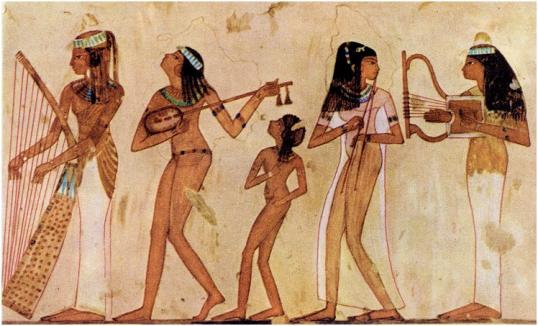
Egyptian Harem with Angle Harp, Lute,
Dancer,Double Pipes & Lyre
Harps were very popular in ancient Assyria and Mesopotamia.
One of the earliest illustrations of a harp was on a vase
found in a Babylonian temple. These harps were angled harps
with 12 to 15 strings and similar to the bowed instruments
played in Egypt about the same time. The angle harp represents
the next step in history towards the modern harp. The angle
harp differs from what we call the harp today in that it lacked
the front-piece, column or pillar. It was played "upside
down" from its present playing orientation, with the
tuning pegs on the bottom.
Vertical harps with 2 arms
also known as lyre harps or "lyres" also began appearing
in ancient Sumaria by 2800 BC. Some of the oldest carvings
of harps were discovered in Phoenicia with marble harp statuettes
found dating back to 3,000 - 2,300 BC. The development of
the lyre harp in Greece also coincided with the development
of mathematical musical scales. By the 6th century BC, Pythagorus
discovered numerical ratios corresponding to intervals of
the musical scale. The Greeks are also credited with inventing
the Aeolian harp, a harp played by the wind.
Clay Tablet with Angle Harp
|
Egyption Bow Harp
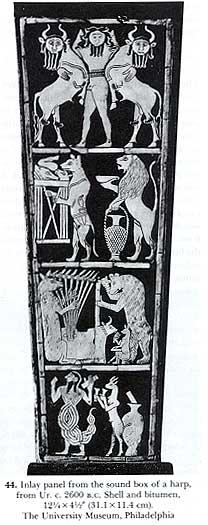
|
Harp from Ur - Circa 2600BC |
Ancient Rome did not seem to
place as high an importance on music compared to other ancient
civilizations. With the decline of the Roman Empire, music
seemed to have died out and there are very few historical
references for a half millenium. In early European society
following the fall of Rome impressions of lyre harps were
found on the coins of pre-Christian Gauls. The harp and musical
culture in general seems to have disappeared in the Dark Ages.
These centuries are shrouded in mystery.
It is not known where or how
the fore-pillar or upright column that created a triangular-framed
harp body came into use. The earliest drawings of triangular-frame
harps appear in the Utrecht Psalter in the early 9th century.
It was the appearance of the harp column possibly during the
early Christian era that marked the advent of the modern harp.
It solved two problems. It allowed the harp maker to increase
string tension without distorting the instrument which also
made the harp easier to tune as changing the tension of one
string no longer affected the tension of all the other strings.
Harps could then be built with more strings with higher tensions,
better volume and tone.
After those centuries of obscurity
in the historical record, the precursor to the triangular
Medieval harp reappeared in Western European civilization.
In the fourth century AD, monk vocalizations predating Gregorian
chanting were used in worship services in the Christian Church.
The harp became a preferred instrument for accompaniment for
the monks' voices. The harp was one of the few instruments
allowed in the early church where the horn, drum and rattles
were considered the devil's instruments. During the fifth
century, the Papal Music School was established in Ireland
where the harp was taught. Fragments of a six-stringed harp
were found in the 7th-century burial ship unearthed at Suffolk
in England. The depiction of a harp was also discovered in
stone carvings dating from the 600's AD in Northumberland.
The remains of several Germanic harps, dating from the fifth
through the tenth century, have been found in Saxon and Frankish
graves in Germany and England.
To be continued….. Medieval
Harps
|

