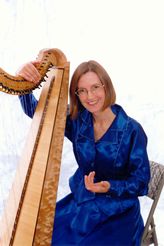
Frequently
Asked Questions
Celtic Harp FAQ - Just why is
that?
I have added this information
feature to the website as I am often performing in public
and field numerous questions about the Celtic harp as
it is the most attractive of instruments. The questions
are generally not overly technical and neither are my
answers. eMail
me with your questions and I will answer them too.
Alison
Vardy
| Celtic
& Paraguayan Harp FAQ |
|
Is
it difficult to play the Celtic harp?
The Celtic harp is a very forgiving instrument in that
it sounds beautiful even when you are just learning.
It takes time, patience and lots of repetition to learn
a comfortable, effective hand position as well as playing
techniques that get the best sound from your instrument.
Do
I need to know how to read music?
The ability to read music is always
an asset, but not a necessity when playing solo and
by ear.
My
child has shown an interest in playing the harp. What
would be a good age to start?
No specific age but when the child
is large enough to sit comfortably on a chair/stool
with their feet on the floor, and can reach the strings
.
What
kind of harp should I get?
Lever harps (celtic harps) are usually less expensive
as well as smaller and easier to transport than pedal
harps. I recommend an instrument with a minimum of 29
- 30 strings that sits on the floor while you are on
a chair or stool (or you can use risers for the harp).
Are
you a harpoonist? (Yes
it has been asked!)
I play the Celtic and Paraguayan harps and call myself
a harpist or "harper".
Is
that a real harp?
Harps come in all sounds, sizes and shapes. A Western
harp constitutes a triangular frame with either an attached
acoustic soundbox (as part of the frame) or with some
electronic wizardry that can pick up the string vibration
and be amplified elsewhere. Harps can vary from 6 to
48 strings when they have a single course (row) of strings.
Double, triple and cross-strung harps can have over
a hundred strings. Read more about these harps in harp
history.
What
are the different kinds of harp?
Many! Defined by:
Numbers of rows of strings:
eg. single-course, double-strung, triple-strung (Welsh),
cross-string
Type of strings - wire-strung,
nylon-string (usually with wire only in bass), gut-strung
Mechanisms for semi-tones
- eg. lev ers (lever harps), pedals (pedal harps), tacitos
(paraguayan harps)
Ethnicity - eg. Kora of Africa,
Koto of Japan, Valiha of Madagascar are all in the harp
family.
Size - eg. lap harps,
floor harps, troubadour harps, even huge wind harp (aeolian
harps)
History - eg. medieval, baroque
harps, arpa doppia of Italy, arpa de dos ordenes of
Spain
Why
are some of the strings coloured?
Coloured strings provide you with signposts for finding
your way around the harp. On lever and pedal harps the
red strings are C's and the black or blue strings are
F's. On Paraguayan harps not so!
What
are the strings made of?
Nylon, nylon wrapped on nylon, gut,
carbon-fiber (synthetic gut), steel, bronze, brass,
metal wound on silk, nylon wrapped on multi filament
nylon.....etc.
Do
you get sore fingers? Do you have calluses?
If my fingers get sore, it has usually started in my
neck & shoulders and I need to take regular breaks
as well as warm-up with stretching before I start playing.
Calluses are very slight when playing on nylon or gut-strung
harps, some wire harp players can develop significant
calluses if they use their finger pads. Most wire harp
players prefer to use their fingernails, hence have
no significant calluses.
What
does a lever do?
Levers are devices for raising the pitch of a string
by one semi-tone. This avoids re-tensioning the string
to change a note. A lever effectively shortens a string
by pinching it or deflecting it sideways by 1/18th of
its length (just like a fret on a guitar does by pressing
a finger). All wire-strung harps often have blades which
deflect the string. Pedal harps have up to 1500 moving
parts to accomplish pitch changes using pedals.

What
is a Celtic harp made of?
Harps are usually made out of hardwoods and sound or
tone woods. The majority of woods used in harp are exotic
woods that impart a particular sound or quality to the
harp. In North America maple, cherry, and mahogany are
often used. The soundboard (where the strings come out
of) is made of more a musical sounding tone wood, usually
sitka spruce. My various harps are made of quilted maple
(the Sandpiper below), Tasmanian acacia blackwood (the
Paraguayan), oak (the Webby), mahogany, cherry and laminates
(the Bresch). Laminates are essentially high quality
plywoods made with hardwoods (ie: maple) and can sound
very similar to a natural wood harp with the added benefit
of increased durability and lower cost.

Sandpiper Nova Celtic - Bresch
Celtic - Webby Celtic harp
- Alison's Paraguayan -
How
often do you have to tune it?
Every time I perform and small tweaking's for practice
at home.
Do
strings break often? Are they hard to replace?
Because of it's low string tension,
the paraguayan harp has never broken a string (11 years
old now!) but the strings still need replacing after
a few years as they lose their "harmonics"
and start to sound dull.
Nylon strings break more
often and gut strings the most often. A lot depends
on the stringband tension that the harpmaker has built
the design of the harp around. The maximum string-breakage
I've had is 6 per year per harp....even fewer as the
harp "settles in".
What
kind of harps are played in the symphony orchestra?
Pedal harps - 47 strings or 7 1/2
octaves, the same as a piano.
What
does harp music look like on the page?
Very similar to piano music with
a right hand (usually the melody) and a left hand (usually
the harmony).
What
does a Celtic harp cost?
Harps can be expensive! Good Western
Canadian folk harps start at about CAD$2500 for a new
beginner harp with a full set of levers and a case.
One can easily spend CAD$6000 for a premium model. USA
harpers substitute US for CAD and you will not be too
far out. It is best to rent if you can for a while to
determine if harping is a "fit" for you. You
can also develop a bit of an ear this way thus choosing
a harp to purchase becomes easier. Orchestral concert
harps start at US$20,000 and the most expensive new
harp I have found to date was UK£150,000 (US$260,000)
||| Ask
Your Question Here |||
eMail me with
your questions and I will answer them too. Alison
|