|
Harp History III Harps have Captivated the Celts for a Thousand Years |
|
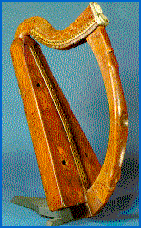
|The Celtic Connection The Irish are generally credited in the popular press with bringing the harp to Europe. It is believed by some scholars that the harp was actually brought to Europe from Egypt by the Phoenicians in pre Christian times as a trade good. The paths of the Phoenicians can be traced by the distribution and acceptance of the harp. Versions of the harp (or Kora harp) exist from the Mediterranean Basin to Northern Europe to cultures all the way around coastal Africa and up to the Island of Madagascar. The harp may have arrived in Europe as well with successive Indo-European migrations from Southwest Asia. The harp has been an important emblem of Irish nationalism since the 10th Century. King Griffith of Wales employed harpists in his court at the end of the 11th century. By the end of the 12th century, manuscript illustrations show harps with more advanced designs. The Irish were by then playing harps with brass, or bronze, strings. Records from the 15th century show that both the terms "harp" and "clarsach" were in use at about the same time and seemed to have been a distinction between gut-strung European-style harps and wire-strung Gaelic clarsachs of Scotland and Ireland. The earliest surviving harps from Scotland and Ireland date to about the 15th century. The Trinity College harp, one of Ireland's national treasures, is the harp from which the national symbol of Ireland is copied. The characteristic shape of an Irish Harp is familiar from Irish coins and bottles of Guiness Beer. Henry VIII of England had the Irish harp impressed on coins after obtaining control over Ireland. For centuries, the harp was an integral part of Irish life. Traveling harpists in Ireland, were known to be at the focal point of rebellions - so much so that the harp was banned. Turlough Carolan (1670-1738), the blind Irish folk harpist, wrote hundreds of tunes - many of them are still very popular today. |

|
The period starting from the 1700s during English rule in Ireland was difficult for Irish harpers as the harp as a folk and court instrument was suppressed to prevent a resurgence of nationalism. Harps were burnt and harpers executed. The tragic extinction of this harping tradition at the end of the eighteenth century had a number of causes: the Angloization of the Irish (and Scottish) cultures, the increased popularity of step-dancing and the fiddle, and the inability of the harp to play the musical accidentals required for classical music, which started coming in to vogue in Dublin and Edinburgh during the then Baroque era. Only in Wales was the Folk harp tradition unbroken . By the late 18th century it was clear that traditional Irish harpers were nearly extinct. Because harp music had always been handed down orally, very little of it has been preserved. The most important attempt was made in 1792. In order to encourage and preserve the old harping tradition, a festival was held in Belfast and newspaper advertisements invited all Irish harpers to come and play for cash prizes. Only ten harpers, ranging in age from fifteen to ninety seven, could be found. A nineteen year old church organist named Edward Bunting was hired to notate the music, but with few exceptions only the melodies, and not the bass lines were taken down. Bunting had so much enthusiasm during the festival that he continued to collect traditional tunes throughout his life, publishing three collections, in 1797, 1809, and 1840. Bunting collected not only the music, but much lore and technical information from the harpers. All of the surviving Carolan melodies date to these works. Few other melodies survive and this proves to be an historic oversight; now we know little about how the harp was actually played. Many harpers also have assisted in the recovery of the lost Celtic harping tradition. In particular, Keith Sanger and Alison Kinnaird have uncovered much fascinating information about the Gaelic harp in Scotland. The resurgence in the late 20th century of the North American traveling Troubadour harper like Sylvia Woods has rekindled interest in the Celtic harp. The international success of the Chieftains and their harper, Derek Bell, led to a resurgence of folk harping throughout Ireland and the rest of the western world. Traditional Irish folk harp makers are now beginning to flourish after a hiatus where only the orchestral harp was to be found in Ireland. In the last few decades the harp has grown in popularity with the likes of harpers Derek Bell, Anne Heyman, Alison Kinnaird, Patrick Ball, Moira O'Hara, Alan Stivell, Kim Robertson, and many others have made wonderful records of Celtic music Today the Irish or Celtic folk harp is again an important part of Irish and world culture. |

|
Credit for the historical content and images on these history pages belongs to: www.celticguitarmusic.com/aboutharp.htm www.harps.com/harphistoryG.htm http://midtown.net/dragonwing/col9810.htm |

|
The delineations between the different types of the western modern harp are usually known as: Celtic or Folk lever harp - Diatonic - tuned in one key with 7 notes with accidentals Concert or Classical orchestral harp - Chromatic - All 12 notes with no accidentals South American harp - Diatonic - Tuned in one key - possibly no accidentals Multicourse harp - Double, Triple or Cross Strung harps - All possibilities of tuning Renaissance or Gothic harp - Diatonic - Tuned in one key or mode - no accidentals |
|
The Trinity College Harp |
|
|Home > Early History > Gothic Harps > The Celtic Connection |

|
|Home > Early History > Gothic Harps > The Celtic Connection |

|
Contact Alison |


|
[ Alison's Concerts | Your Event | Weddings | Bereavements | Lessons | Workshops | Schools ] [ Alison's CDs | CD: Apasionada | CD: Harping On | Buy CD | Biography | Alison's Harps ] [ Photos | Reviews | Clippings | Harp History | Harpsound Amplification | Dance & DJ ] [ Guarantee | Promotion Kit | Contact Alison | Links | Site Map | Home ] |