
|
Contact Alison |
|
Harp History II Harps in the Middle Ages |
|
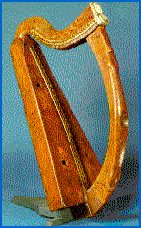
|Gothic Harp History The harps played by the harpers of the old Gaelic orders were an aristocratic instrument, played in the courts of kings and before the chiefs of clans. It had an important role in Gaelic culture, legend and folklore. About the 13th century, when Feudalism reached its height, the Troubadours began appearing. European harpers earned their living by moving from town to town, using small harps for self-accompanied singing, storytelling, news-telling and in instrumental groupings. Harpers were second only to the chieftain or king, often serving as advisors and leading armies into battle. Unarmed, they were recognized and respected by the enemy and were generally immune from harm. The age of chivalry with its troubadours and minstrels began a new renaissance in harps. The Medieval harps during this time were small enough to be held on the player's lap, and had between 7 to 25 strings and they had narrow sound boxes often carved out of a solid log. Medieval harps were apparently wire strung although gut, hair and plant materials were used as well. By the 11th or 12th century, the upper neck begins to assume the contours of what we call the "harmonic curve" which attempted to more closely match the string's length with its frequency or pitch. During the middle of the 14th to 16th century, larger harps known as Gothic harps appeared. This harp had around 24 gut strings, a tall instrument and is the ancestor of the Spanish Renaissance harp, the folk harps of Latin America, the orchestral or "Concert" harp and possibly the modern "Irish" or "Celtic" harp. |


|
In the 1600s, the Gothic harp or the then version known as the Spanish or Renaissance harp was taken to the new world by Jesuit missionaries and developed in a completely different way. The indigenous peoples were fascinated with the instrument, made some changes to it and adopted it as part of their own culture. There are many kinds of harps in Latin America, including the Venezuelan harp, Mexican harp and arpa llanera - harp of the plain. Almost all South American Countries have their own versions of harps. In construction and playing techniques, these harps are quite different from the traditional European harps. They were made of thin wood (cedar and pine) and were much lighter than the European harp. The strings were routed up the centre of the neck and the instruments were bi-symmetrical resulting in few structural stresses. Eventually tacitos were used to sharpen notes to change key. The playing style and techniques were vibrant and dynamic in contrast to the softer European tone. Modern Paraguayan harps usually have 36 nylon strings tuned to the diatonic scale and are played with the fingernails. The sound is bright with a shorter sustain period after the plucking of each note.. In Europe, the Renaissance (or the later version of the Gothic harp) remained only capable of playing seven notes per octave. The major composers of the 16th to 18th centuries demanded all 12 chromatic notes of the scale. One solution was a chromatic harp, a harp with 12 strings per octave . Chromatic harps were built in Spain in the 16th and 17th century. A double harp with two rows of strings was built in 1581. Soon afterwards, the triple harp appeared where the player would reach between two diatonic scaled rows of outer strings to play the chromatic notes in between. The double and triple harps continue today in the Welsh tradition. |


|
Credit for the historical content and images on these history pages belongs to: www.celticguitarmusic.com/aboutharp.htm www.harps.com/harphistoryG.htm http://midtown.net/dragonwing/col9810.htm |
|
Note the lack of a soundbox on this Gothic Harp |
|
|Home > Early History > Gothic Harps > The Celts |
|
Although these were forward leaps, these attempts made the harp difficult to play and awkward. Musical composers continued either to ignore the harp or include it sparingly for glissandos, arpeggios and "harpy effects". The pedal harp was invented in 1720 with the first single-action pedal harp which could raise the pitch of the selected strings by a half step, allowing the harp to be chromatic and be played in most keys. The pedal harp was improved in 1750 when the early pedal-operated string catching hooks were replaced with metal plates that gripped the strings while leaving them in the same plane, and in 1792 rotating disks were substituted for the metal plates. Later the double-action harp was developed, where a string could be raised or lowered a semi-tone. To be continued….The Celts |Early History > Gothic Harps > The Celts |


|
[ Alison's Concerts | Your Event | Weddings | Bereavements | Lessons | Workshops | Schools ] [ Alison's CDs | CD: Apasionada | CD: Harping On | Buy CD | Biography | Alison's Harps ] [ Photos | Reviews | Clippings | Harp History | Harpsound Amplification | Dance & DJ ] [ Guarantee | Promotion Kit | Contact Alison | Links | Site Map | Home ] |